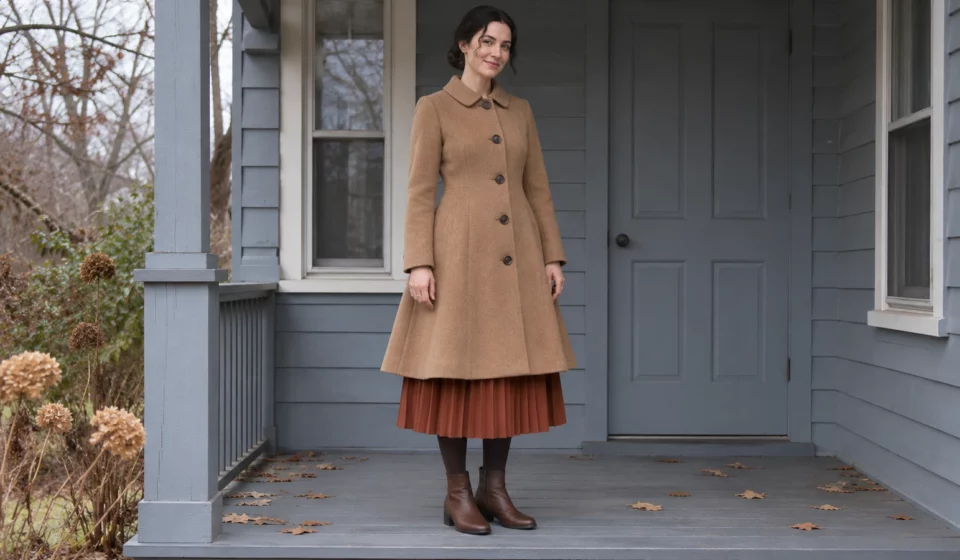

Two coats can end at your knees and do entirely different things to the pleats below them. Button a straight coat over a full skirt and you might find a handful of fabric caught behind one hip. Try a coat that flares from the waist and those same pleats may open with each step. Choose the coat you can fasten, sit in and walk away in with the skirt still hanging the way you like it.
See where the skirt opens out
Start in the complete outfit, down to your tights and boots. Suppose it’s a rust pleated midi, a fine cream sweater and brown ankle boots. Turn sideways. Does the skirt spring out just below the waistband, or do its pleats stay stitched down over your hips before they open? That’s where your coat will first need room for the extra cloth. It’s easier to fit one layer over another when you can point to the first place the cloth needs to spread.
Walk to a chair, sit, then stand without smoothing the skirt. See where the hem comes to rest behind each calf. If one side is already up, check whether the skirt has caught on a boot top. Free it and repeat the walk. You now know how the skirt behaves before a coat enters the picture.
Try the straight coat fully fastened
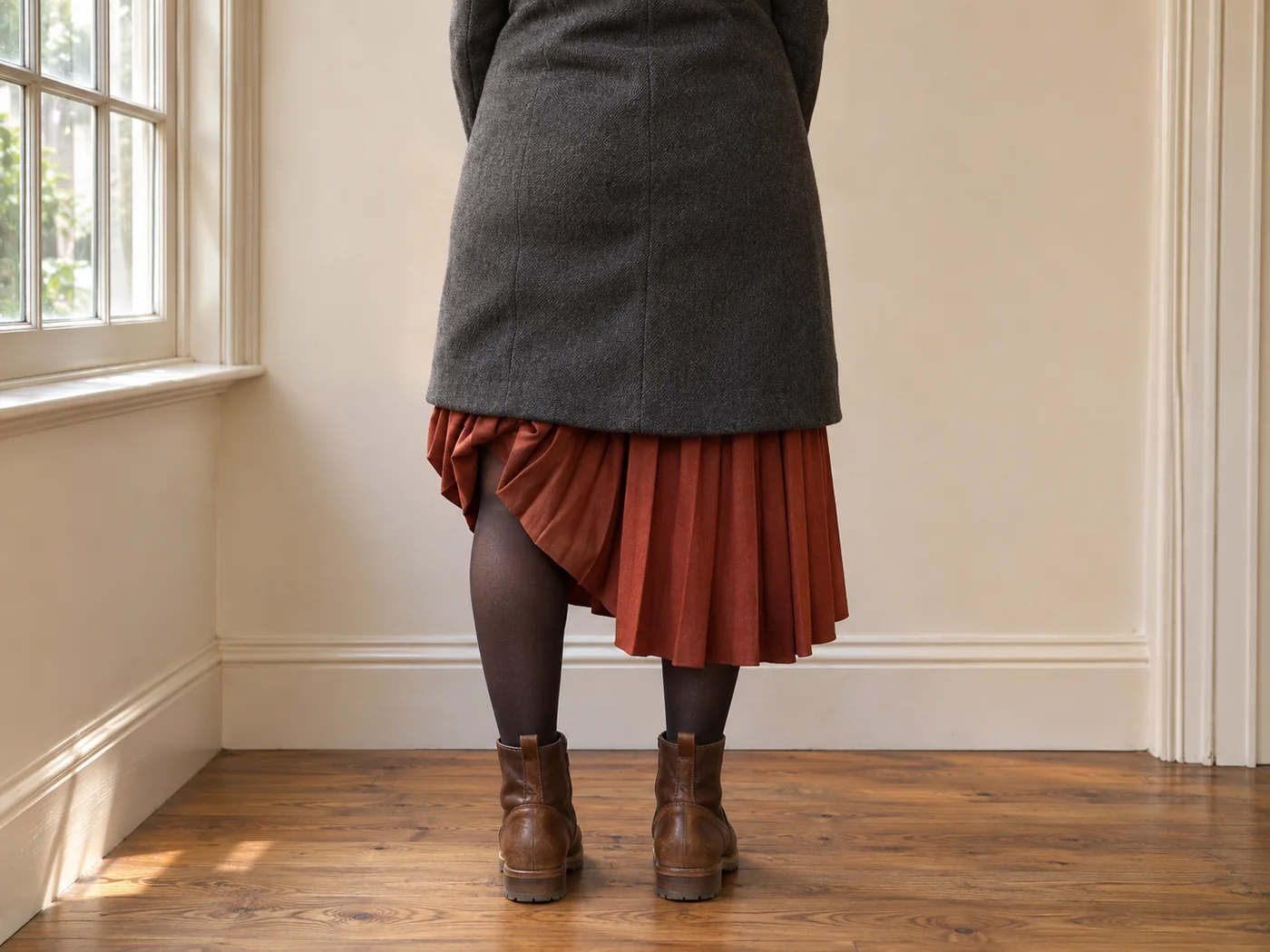
Put the coat on and close the buttons or zip you use outdoors. If it has a belt, tie it as you ordinarily would. Notice where the lowest fastening lands against the pleats. A coat that buttons only to the waist may let the skirt fan out below it. On a straight coat that closes to mid-thigh, more of the skirt has to fit inside the closed front.
Take three or four ordinary strides. Stop and use a second mirror or a timer photo to see the back without twisting round. Look at the amount of skirt showing on each side. If a neat band of rust has become a diagonal, open the coat and see which fold drops. Repeat once. A skirt that catches in the same place each time gives you a reason to try a different cut.
Change the sweep and try the chair
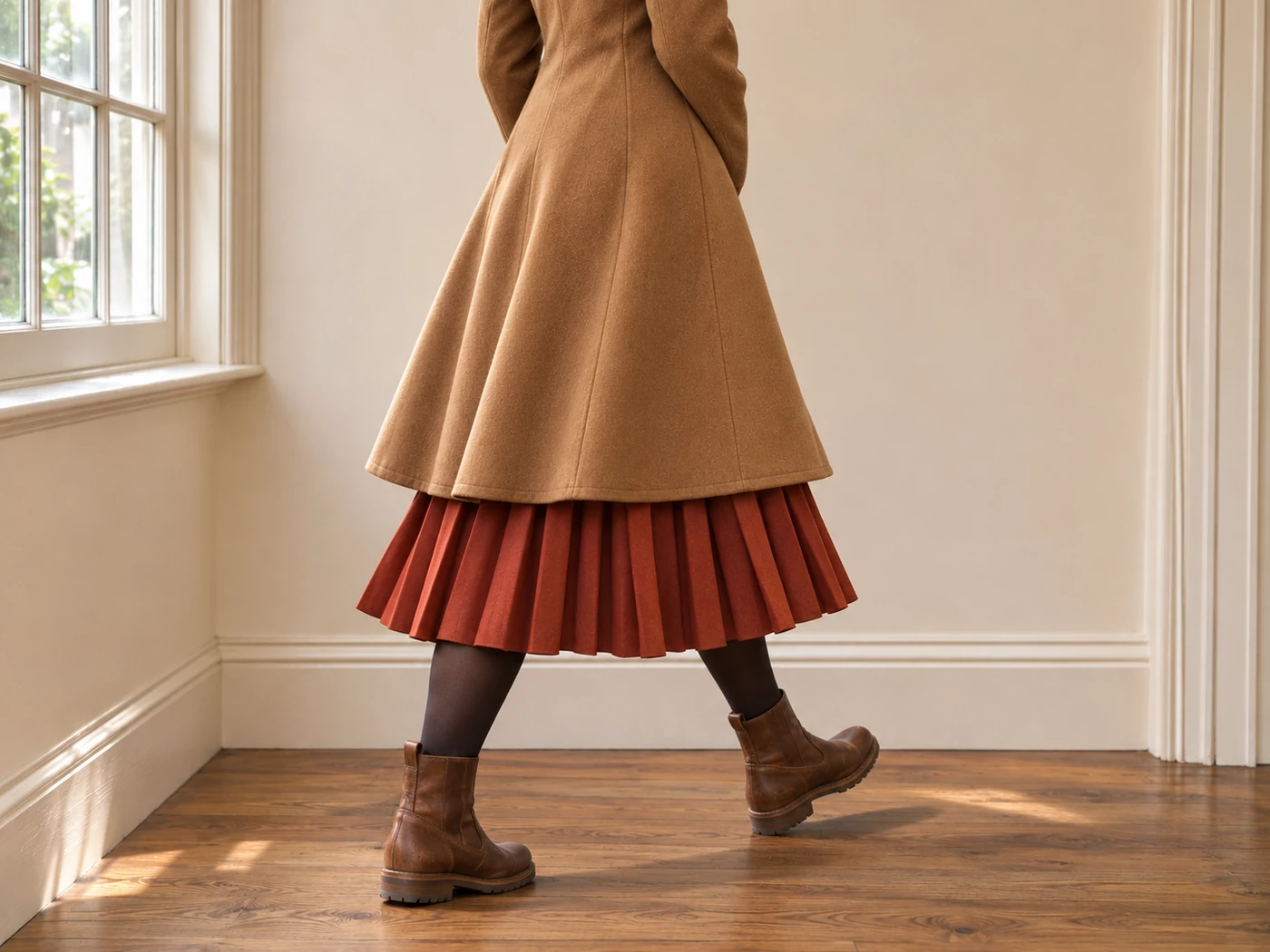
Keep the skirt and boots. Put on an A-line coat of similar length and fasten it. Its sweep is the room around its lower edge. Slide a hand down the side from hip to hem. Where the straight coat pressed the folds together, you may now feel them hanging vertically. A straight coat with enough width can pass this check too.
Sit back on the chair with both feet on the floor. Free any coat tail pinned beneath you, then lean forward as if lacing a boot. If the outer cloth still feels loose while a band inside pulls taut across your lap, look at the coat lining. Open the front just enough to see whether it has carried a handful of skirt up with it. Smooth the two layers apart, refasten and sit again.
Which folds belong there?
A small horizontal fold at the bottom of an attached lining can be deliberate. It gives a little length when you sit, as Susan Khalje shows in her explanation of a lining’s jump pleat. Stand up and walk a few paces. Can you take your usual stride, and do the skirt folds fall free when you stop?
How much coverage does the day need?
- For a windy wait outdoors, try the longer coat fully closed with your bag on your shoulder. Walk up a step. A little skirt showing can be lovely if the coat gives you the coverage you want and the hem clears your boot.
- For a short trip in mild weather, try a cropped jacket that finishes above the place where the skirt opens out. Close it and sit down. If its bottom band grips a row of pleats, go a little shorter or try a looser band.
Give the straight coat another outing with a less full skirt if you love its shape. For the rust midi, let the view after the walk decide. That’s the coat you’ll be glad to pull on when you have one hand on the door and the other full of gloves.